
AUKUS at the watershed
Why three capitals signed, what the official case glosses over, and what the wager really costs.

For decades Australian defence planning rested on a comfortable assumption, embedded in policy as recently as the 2016 Defence White Paper: around ten years of strategic warning time before any serious threat to the nation could materialise. That assumption is dead. The 2020 Defence Strategic Update discarded it as a basis for planning, and the Defence Strategic Review of 2023, commissioned within the first hundred days of the Albanese government and delivered by Stephen Smith and Angus Houston, buried it. The 2026 National Defence Strategy went further: mere ‘deterioration’ was no longer adequate to describe Australia’s strategic environment. Australia now faces ‘force projection risks not seen since WWII’. That phrase should discomfort anyone who reads it slowly.
The environment that dissolved the warning time assumption is not obscure. China’s military modernisation has been the fastest sustained build-up by any power since the Second World War. The People’s Liberation Army Navy is projected to field eighty submarines by 2035 on the Pentagon’s own projections, against a US fleet expected to hover in the mid fifties through the 2030s. The PLA’s development of area denial and anti-access capabilities (long-range precision strike, hypersonic glide vehicles, anti-ship ballistic missiles) has progressively compressed the operational freedom that US and allied forces previously took for granted in the Western Pacific. The South China Sea has been militarised in defiance of international law and the landmark 2016 arbitral tribunal ruling. Taiwan faces military pressure of an intensity not seen for decades. And these developments have coincided with the strategic shock of Russia’s full scale invasion of Ukraine, which reminded a generation of policymakers that the post-Cold War assumption of perpetual great power peace was, at best, a product of historically exceptional conditions.
It is against this backdrop that AUKUS must be understood. Announced on 15 September 2021 by Prime Ministers Morrison and Johnson alongside President Biden, AUKUS is not a defence procurement arrangement. It is the most consequential strategic decision Australia has made since the Second World War: a generational commitment that reshapes Australia’s alliance relationships, industrial base, strategic posture, and relationship to the rules based international order. The Economist reached at the time for the largest available comparison: Nixon going to China in 1972. My assessment in this post is that the strategic logic of AUKUS holds, but not always for the reasons Ministers give for it, and the official case glosses over three things that deserve harder scrutiny: a certification clause in US law that could yet unravel Pillar 1, a cost counterfactual that is more complicated than either the boosters or the critics allow, and a workforce mountain that is the real schedule risk. The strategic alternatives are still worse. But a wager this large should be argued for with its weaknesses on the table.
Three capitals, three bargains
AUKUS is routinely analysed as an Australian acquisition program with two foreign suppliers attached. That framing misses what makes the arrangement durable. Each of the three capitals signed because AUKUS solves a different national problem, and the durability of the enterprise rests on the fact that the three bargains, while different, are compatible.
Canberra: capability that cannot be acquired any other way
Australia’s problem in 2021 was that its submarine plans had collapsed into its strategic circumstances. The Attack class program would have delivered a conventionally powered boat, late, into an environment where the warning time assumption underwriting a conventional fleet had already evaporated. For a continental nation whose maritime approaches span two oceans, the operational geometry of the 2030s demands boats that can transit vast distances submerged, remain on station for months, and hold an adversary’s forces at risk north of the equator. Only nuclear propulsion delivers that geometry, and of the countries with nuclear-powered submarines, two were allies. AUKUS gave Australia access to the most closely guarded military technology the United States has ever shared with anyone other than Britain, and with it a path to a sovereign capability that no amount of money could otherwise buy. It also gave Canberra something less tangible and arguably more valuable: a depth of embedding in the US strategic calculus that no treaty text alone could achieve. A nation whose security depends on allied deterrence has a first order interest in making itself structurally difficult to abandon.
London: industrial continuity and strategic relevance
The British bargain is the least discussed and among the most compelling. The UK’s submarine enterprise at Barrow-in-Furness lives or dies on drumbeat: the continuous flow of design and construction work that keeps a nuclear shipbuilding workforce in being. Between the Dreadnought ballistic missile submarines and the next generation attack boat, Barrow faced a design and production gap of the kind that hollowed out the enterprise in the 1990s and from which it took two decades to recover. AUKUS fills that gap. The British led design for SSN-AUKUS gives the Royal Navy its next attack submarine with a partner sharing the development burden and a second production line at Osborne extending the class. The UK’s Strategic Defence Review 2025 is explicit that the ambition to grow the attack submarine fleet ‘to up to twelve’ runs through the AUKUS programme. And for a post-Brexit Britain that tilted to the Indo-Pacific in 2021 and elevated the region to a permanent pillar of its strategy in the 2023 refresh, while struggling to give the tilt content, AUKUS is the tilt made concrete: a fifty year strategic commitment, formalised in the Geelong Treaty of July 2025, that anchors Britain in the region where this century’s balance of power will be decided.
Washington: posture, burden sharing and an ally worth having
The American bargain is concrete and measured in geography. HMAS Stirling sits on the Indian Ocean at the hinge of the Indo-Pacific, thousands of kilometres closer to the critical sea lanes than Guam or San Diego. Submarine Rotational Force-West gives the US Navy forward maintenance, forward crew rest and forward presence, which in practice means more boats on station for the same fleet. Australia’s $3 billion contribution to the US submarine industrial base is cash into the constraint that worries Congress most. And AUKUS converts a capable middle power ally into an operationally integrated one: a navy operating the same boats, trained in the same schools, maintained in the same yards, across the sea lanes through which roughly 75 per cent of Australia’s exports and a substantial share of the world’s trade move. The doctrine of integrated deterrence, which the Biden administration placed at the centre of the 2022 US National Defense Strategy, holds that deterrence is most effective when allies contribute capability across domains and regions rather than sheltering under American power. AUKUS is that doctrine operationalised. When the Trump administration’s Pentagon reviewed the arrangement in 2025, the review concluded with endorsement, and ASPI’s Jennifer Parker explains why: ‘the pact is complex and risky, but Washington stands to gain too much to abandon it.’
Three capitals, three bargains, one enterprise. Each partner is solving a different national problem with the same program, which is precisely why the program has survived changes of government in all three.
Why three, not two
There is a question buried in that architecture worth drawing out, because the answer explains why the United Kingdom is in the room at all. In the early discussions preceding the September 2021 announcement, a recurring American doubt surfaced quietly: whether a country with no civil nuclear industry, no nuclear navy and no history of operating a reactor at sea could responsibly own and run one, and whether Australia was serious enough to see a fifty year endeavour through. The doubt was not unreasonable. It echoes still in the scepticism, much of it Australian, about whether the workforce and the safety culture can be built in time, and it surfaced again in the 2025 Pentagon review’s anxiety about handing scarce boats to an untested operator.
The United Kingdom is part of the answer to that doubt. It is the only country ever to have shared in United States naval nuclear propulsion technology, and it resembles Australia, in the scale of its enterprise and the resources a government can bring to bear, far more closely than the United States does. Bringing Britain in imports into Australia’s enterprise the one ally that has already walked the path from non-nuclear navy to nuclear one, and it gives Canberra a second industrial base, a second training system and, not least, greater collective weight in Washington than it would carry alone. A trilateral arrangement reassures the American system in a way a bilateral one could not: the model of transferring this technology to a trusted ally is not a leap into the dark, because it has been done once before.
The precedent is exact, and it is instructive that it began in suspicion. When the Royal Navy sought American naval reactor technology in the 1950s, the father of the United States nuclear navy, Admiral Hyman Rickover, at first resisted, even blocking Earl Mountbatten’s tour of USS Nautilus on the ground that the cooperation agreements did not extend so far. He relented only after concluding that Britain was a serious and enduring ally, and the transfer of a complete American submarine propulsion plant was made possible by the 1958 US-UK Mutual Defence Agreement, which put an American S5W reactor into Britain’s first nuclear submarine, HMS Dreadnought. The doubt that attended Australia’s entry in 2021 is the same doubt that attended Britain’s in the 1950s, and the resolution rhymes: shared technology of this sensitivity flows on the strength of trust, demonstrated over time, and the United Kingdom’s presence in AUKUS is partly a standing demonstration that the model works.
The grand strategic logic
Deterrence as the organising principle
AUKUS was born from a recognition that deterrence in the Indo-Pacific of the 2020s and 2030s requires more than good intentions and diplomatic relationships. Deterrence requires capability. And capability at the scale required to shape the behaviour of a nuclear armed great power, to deny it the ability to coerce or project force with impunity, requires the kind of sustained, deep investment in military industrial capacity that only a generational commitment can deliver.
The 2024 National Defence Strategy enshrined a ‘Strategy of Denial’ as ‘the cornerstone of Defence planning’. This is a precise strategic concept, not a platitude. Deterrence by denial differs from deterrence by punishment: rather than threatening devastating retaliation after aggression occurs, it aims to convince a potential adversary that the military cost of attempting force projection against Australia or its interests in the maritime approaches would be prohibitive. A fleet of nuclear-powered attack submarines operating across Australia’s vast maritime geography is the archetypal instrument of denial. It cannot be located, it cannot be fixed, and it cannot be destroyed before it delivers a lethal response.
The five tasks assigned to the Australian Defence Force under this framework (defend Australia and the immediate region, deter through denial any attempt to project power through the northern approaches, protect Australia’s economic connections, contribute to Indo-Pacific collective security, and contribute to the global rules based order) form a coherent hierarchy. AUKUS is the force structure that makes the second, fourth and fifth tasks credible rather than aspirational.
The alliance architecture
Australia does not stand alone. The US alliance remains, as the 2026 NDS states, the ‘foundational partnership’ of Australia’s strategic architecture. But AUKUS is not Australia free riding on US capability. It is Australia making a concrete, costly and durable contribution to the architecture of Indo-Pacific security that the United States requires its allies to provide. National Security Advisor Jake Sullivan captured the logic at the March 2023 Optimal Pathway announcement: AUKUS represents, for Australia, not just a long term investment in nuclear-powered submarines but ‘a long-term investment in its alliance with the United States of America’, a commitment he measured in decades and perhaps a century. AUKUS is not a transaction. It creates interoperable allied undersea capability across the full geographic arc of the Indo-Pacific, integrated with the Quad’s diplomatic engagement, Five Eyes intelligence sharing and the broader US alliance network. AUKUS provides the military technological capability that the other minilaterals lack.
International order and the revisionist challenge
The deeper rationale rests on a theory of international order. Hedley Bull’s conception of international society, the idea that states share a common interest in maintaining at minimum the rules of coexistence (sovereignty, non-intervention, the sanctity of agreements), provides the normative foundation; I have written about Bull’s framework and its Australian application elsewhere. Australia has prospered for eighty years within a rules based order anchored by US military power and institutionalised through the UN system, the WTO, UNCLOS and the NPT architecture. That order is now under systemic challenge from revisionist states, principally China and Russia, that seek to reshape the norms and institutions that have underpinned post-war stability.
The 2026 NDS puts it starkly: the order is ‘in transition’, the end state is difficult to predict, and the coming decade ‘will likely be defined more by fracture, rivalry and disorder’. This is not alarmism. It is a sober assessment of a world in which the UK’s Integrated Review Refresh identified China as ‘an epoch-defining and systemic challenge’. Australia’s choice, in this environment, is not between peace and conflict. It is between shaping the strategic environment through active contribution to allied deterrence, or accepting the consequences of a power transition managed on terms set by others. AUKUS is Australia’s answer to that choice.
Denying hegemony: the cognitive, grand strategic and operational case
Beneath the official language sits the argument that does the real work: AUKUS exists to deny China a hegemonic position in the Indo-Pacific. This is the claim most worth stating openly and testing hardest, because it is the one Ministers most often imply and least often defend. Hegemony is not invasion. It is a condition in which one power’s preferences become the default setting of a region, and smaller states adjust to them before being asked. The question is whether AUKUS, and the nuclear submarine specifically, actually frustrates that condition. The honest answer is that it does, at three distinct levels, with the strength of the claim varying at each.
The first level is cognitive, and it is the most important and the least understood. Hegemony works in the mind before it works on the map. It succeeds when a smaller state concludes that resistance is futile, that the military future of its region is already settled, and that the prudent course is to accommodate in advance. The deterrent value of a survivable submarine force is that it refuses that conclusion. An adversary cannot reliably find an SSN, cannot fix it, and therefore cannot discount it from any calculation. It injects permanent uncertainty into a coercive plan, and uncertainty is the solvent of hegemonic confidence. Tested, the claim holds, but conditionally: the cognitive effect is generated by the prospect of the capability, not its press release, and it is mortgaged to delivery. A program that visibly slips its schedule produces the opposite cognitive effect, telling the region that the balance is shifting the other way. The clearest validation that the cognitive mechanism is real comes, perversely, from Beijing: a government indifferent to AUKUS would not spend the diplomatic capital it has spent at the IAEA and across Southeast Asia trying to strangle it.
The second level is grand strategic, and here the claim must be stated carefully or it collapses. Australia cannot balance China. No middle power can. What AUKUS does is add a node to a distributed system of balancing, in which the cost of regional dominance is raised not by any single state matching China hull for hull, but by a coalition, the United States, Japan, South Korea and India (with the Southeast Asian states hedging quietly), each raising the price in its own way. Australia’s contribution is a high end, sovereign capability positioned at the geographic hinge between the Indian Ocean and the archipelago, complicating any attempt to establish uncontested access to either. Tested, the claim is valid only as a contribution to collective balancing, and only while the United States remains engaged. That is the same dependency examined below under entrapment and abandonment: the hegemony denial logic at the grand strategic level is real, but it is contingent on an American commitment that AUKUS is partly designed to secure but cannot guarantee.
The third level is operational, and it is the most concrete. Denying hegemony in maritime Asia means denying sea control, and sea denial is exactly what an SSN does. Operating in the choke points to Australia’s north, it holds an adversary’s surface and subsurface forces at risk, threatens the sea lines on which any sustained projection of force depends, and makes the establishment of regional sea control prohibitively expensive. Tested against the arithmetic set out below, the operational claim is bounded: a fleet of eight yields two or three boats deployable at once, so Australia raises the cost of dominance, it does not unilaterally deny it. But sea denial is a coalition effect, and a handful of Australian SSNs operating alongside US and allied undersea forces across the same arc is a serious complication for any planner in Beijing. The operational case is the soundest of the three, provided the boats and the crews actually arrive.
Choosing the future, rather than having it imposed
The second argument is normative, and it is the one closest to why this matters beyond the order of battle. A middle power’s sovereignty is not only a legal fact. It is a practical capacity: the ability to make consequential choices, about trade, alignment, values and security, without those choices being foreclosed by another power’s coercion. In a region trending towards a single dominant pole, the choice set of every smaller state narrows, and it narrows quietly, through anticipated reaction, long before any shot is fired. Agency erodes first. The deepest argument for AUKUS is that it preserves Australia’s capacity to choose its own future rather than have one imposed on it.
What the nuclear submarine does for that argument, specifically, follows from three of its attributes. It is survivable, so it cannot be removed cheaply in a first move, which means it cannot be discounted by anyone seeking to compel Australian acquiescence. It is independent, able to operate at intercontinental range without staging through anyone else’s territory or asking anyone’s permission, which is the physical expression of an autonomous foreign policy. And it is persistent, holding its position for months rather than days, so that the capacity to resist coercion is continuous rather than episodic. A country that fields such an instrument is materially harder to coerce, and a country that is harder to coerce keeps more of its choices. That is the link between a reactor at sea and a sovereign destiny.
Tested, this claim carries the sharpest internal tension in the whole enterprise, and it should be faced squarely rather than asserted away. The autonomy AUKUS buys is real, but it is purchased with a deeper dependence on the United States, examined immediately below. Australia gains freedom from coercion by a potential adversary and accepts, in exchange, a reduction in its freedom of action relative to its principal ally. That is a defensible trade, in my view the right one, because the alternative is not pristine independence but exposure without the means to act on any choice at all. But it is a trade, and the ‘choose our own destiny’ framing only survives the test if sovereign control of the capability is genuinely achieved rather than nominal: Australian crews, Australian sustainment, Australian command and an Australian regulatory and decision making chain that can in fact say no. That is why the sovereign-ready workforce and the domestic safety regulator are not administrative details. They are the difference between a capability Australia owns and one it merely hosts, and therefore the difference between an argument for autonomy that holds and one that hollows out.
Testing the official case
The hegemony and autonomy arguments above carry their own tests with them. Three further claims remain to be examined, the ones the official case states most confidently and defends least: that embedding with the United States is an unalloyed gain, that buying capability is the same as generating deterrence, and that ‘eight submarines’ means what the public hears. Each is true as far as it goes. None should be accepted at face value.
Embedding cuts both ways
The strongest claim in the official case, alliance embedding, is also the least examined. It is true that operational integration raises the cost of any adversary action against Australia. It is equally true that it binds Australian decisions to American ones. This is the oldest dilemma in alliance management: the fear of abandonment and the fear of entrapment pull in opposite directions, and every measure that reduces one increases the other. AUKUS is a large purchase of insurance against abandonment, paid for in entrapment risk. The Government insists the submarines will be under sovereign command, and in law they will be. In practice, a force whose training pipeline, doctrine, weapons, maintenance and intelligence picture are jointly produced with the US Navy is sovereign in the sense that matters least in peacetime and most in a crisis: the legal right to say no. That right must remain. The practical cost of exercising it will rise with every year of integration. My judgement is that the trade is the right one, because the realistic alternative to entanglement with Washington is not strategic independence; it is strategic weight loss with the same exposure. But it is a trade, and Ministers would serve the public better by defending it as one rather than asserting that sovereignty is untouched.
Deterrence is a relationship, not a procurement
The second test is the deterrence claim itself. What Australia is buying is capability. Deterrent effect is generated somewhere else entirely: in Beijing’s assessment of allied will, cohesion and competence. On that measure the 2021 announcement was itself probably the largest single deterrence signal of the enterprise: three governments demonstrating they would absorb enormous cost and political risk together. But signals run both ways. A flagship program that visibly slips, gets reviewed, or fails a legislated test becomes a signal of its own, and not the intended one. The deterrent value of AUKUS is mortgaged to its delivery.
There is also a question of what, precisely, is being deterred. A fleet of SSNs operating in the archipelagic choke points to Australia’s north makes any projection of force against Australia, and any attempt to cut its sea lanes, prohibitively costly. That is deterrence by denial working as the strategy intends. Its contribution to deterring a move against Taiwan is a different and more modest claim: real, but marginal, and running through the US fleet rather than through anything Australia does independently. The official rhetoric sometimes elides the two. The submarines deter coercion of Australia. They do not, by themselves, change the cross strait calculus, and the case for them should not pretend otherwise.
The arithmetic of presence
At the military strategic level, the test is arithmetic. Submarine fleets follow a rule of three: at any moment, roughly a third of the force is in maintenance or deep upkeep, a third is in training or transit, and a third is available for operations. Eight boats means two, sometimes three, on station. Marcus Hellyer’s pre-AUKUS analysis made the same point about the Collins fleet: the usage and upkeep cycle yields two deployable boats, and given the transit distances to Australia’s operating areas, even one boat reliably on station could not be assured. The official formulation of ‘eight nuclear-powered submarines’ invites the public to imagine eight boats at sea. Force planners plan on a third of that.
The geometry argument survives the arithmetic, which is precisely why nuclear propulsion was worth the premium: an SSN spends days in transit where a conventional boat spends weeks, and once on station it stays. One SSN north of the equator generates more presence, and more uncertainty in an adversary’s planning, than the whole deployable conventional fleet could. But honesty requires the conclusion to be stated plainly: the 2040s force will be potent and thin. Eight hulls is a floor for strategic effect, not a margin.
The timing problem and the certification trapdoor
The strategy says the danger is now. The first Australian flagged Virginia is scheduled to arrive in 2032, SSN-AUKUS in the early 2040s, the full fleet in the mid-2050s. SRF-West covers the gap, but with allied boats under allied command: the strategic effect is real, the sovereign control is not. Whether the force Australia has today could fight tonight is a question I have addressed elsewhere; AUKUS is the answer to the decade after next, and the official case is at its weakest when it implies otherwise.
And in the middle of the pathway sits a trapdoor. Under the transfer legislation, the US President must certify to Congress, no later than 270 days before the first transfer, that the sale ‘will not degrade’ US undersea warfare capability and that submarine production and maintenance investment is sufficient to meet the needs of both nations. At today’s production rate of 1.1 boats per year against the 2.33 the US Navy says it needs, a president applying that statute honestly could not sign. The certification therefore depends on an American industrial recovery that Australia can influence at the margin, and is paying to influence, but cannot control. The Chief of Naval Operations told Congress in May 2026 that the two a year rate will arrive in the 2030s; the certification falls due in 2031. The December 2025 ‘full steam ahead’ directive is welcome, but a directive is not a production rate, and the decision to transfer in-service boats rather than new construction lowers the bar without removing it. What the official case lacks, and what a parliamentary inquiry should demand, is a stated hedge: what Australia does in 2031 if the certification cannot be made. Protecting the Collins life of type extension schedule, institutionalising SRF-West, and holding open an expanded rotational presence as the fallback are the obvious elements. Hedging is not defeatism. It is what serious programs do, quietly, and this one shows no public evidence of doing it.
Pillar 1: nuclear-powered submarines and the strategy of denial
Nuclear-powered, not nuclear-armed
The first and most important clarification about Pillar 1 is definitional. These submarines are nuclear-powered, not nuclear-armed. They carry no nuclear weapons and Australia will not acquire nuclear weapons under AUKUS. The March 2023 announcement is explicit: Australia ‘will not seek to acquire nuclear weapons’. The strategic rationale for nuclear propulsion has nothing to do with nuclear weapons and everything to do with physics and operational geometry.
A nuclear-powered attack submarine is a fundamentally different instrument from a conventional diesel electric boat. The Collins class submarines Australia currently operates, capable and world class in many respects, are constrained by the physics of their propulsion. They must periodically snorkel to recharge batteries, which limits their endurance at speed, their stealth during approach and their operational range. An SSN carries no such constraint. It can remain submerged for months, operate at high speed without compromising its noise signature, transit the full extent of Australia’s maritime approaches and sustain operations at any depth. As Luke Gosling put it at the Lowy Institute launch of his ‘Deterring at a Distance’ paper on the strategic logic of AUKUS, introduced by Deputy Prime Minister Richard Marles:
SSNs are overwhelmingly in Australia’s interest because they strengthen our ability to deter war by threatening painful consequences for aggression against Australia, its partners, and its interests… SSNs are worth the significant cost and effort of building them because they are optimal instruments of deterrence.
For a continental nation with a 36,000 kilometre coastline and maritime approaches spanning the Indian and Pacific Oceans, the tyranny of distance, historically Australia’s principal strategic vulnerability, becomes with SSNs a strategic asset. These boats can operate north of the equator, in the littorals of Southeast Asia, in the deep ocean approaches to the northwest, and in the choke points of the archipelagic geography to Australia’s immediate north. As ASPI’s analysts note, ‘a nuclear submarine can protect Australia but can also hunt enemy vessels in a sea battle north of the equator. That’s a better warfighting capability, and therefore a better deterrent.’
The Optimal Pathway
The Optimal Pathway, announced at Point Loma Naval Base, San Diego, on 13 March 2023 by Albanese, Sunak and Biden, is a phased approach that manages the gap between Australia’s immediate strategic need and the longer term goal of a sovereign SSN capability.
The first element is Submarine Rotational Force-West. From as early as 2027, one UK Astute class submarine and up to four US Virginia class submarines will rotate through HMAS Stirling near Perth. This is not a permanent basing arrangement, consistent with Australia’s bipartisan policy against foreign bases on Australian soil, but a rotational presence that creates immediate strategic effect. The May 2026 AUKUS Defence Ministers joint statement confirmed the pace: SRF-West stands up in 2027, and the United States had that month ‘authorized establishment of the U.S. Navy support elements for SRF-West’.
The second phase is the Virginia class purchase. Starting in the early 2030s, under Congressional authority already granted in the FY2024 National Defense Authorization Act, the United States intends to sell Australia three Virginia class submarines, with options for up to two more. The first sale is scheduled for 2032, followed by 2035 and 2038.
The third and culminating phase is SSN-AUKUS: a trilaterally developed submarine based on the UK’s next generation SSN design, incorporating US submarine technologies. The UK will deliver its first SSN-AUKUS to the Royal Navy in the late 2030s; Australia’s first Australian built boat will follow in the early 2040s. The long term goal is a Royal Australian Navy fleet of eight nuclear-powered submarines by the mid-2050s, a commitment cemented by the Geelong Treaty, the fifty year bilateral agreement covering design, build, operation, sustainment and disposal.
What SRF-West means operationally
The significance of SRF-West extends well beyond its immediate deterrence contribution. The Australian Submarine Agency captures the logic: SRF-West will help Australia build the operational capabilities and skills to be ‘sovereign ready’, so that Australia can safely own, operate, maintain and regulate a nuclear-powered fleet from the early 2030s. This is the knowledge transfer phase: Australian naval officers completing US Nuclear Power School, maintenance personnel working alongside US and UK counterparts, and the institutional culture required to operate nuclear-powered submarines safely being built into the Navy before the first Virginia class boat is transferred.
As of May 2026, over 120 Australian sailors and officers are completing joint nuclear submarine training. HMS Anson completed the first UK submarine maintenance period at Stirling in early 2026. USS Vermont completed a major trilateral maintenance period there in October 2025. These are not symbolic gestures. They are the operational foundations on which sovereign capability will be built.
The nonproliferation framework
AUKUS has been attacked as a proliferation threat, and the concern deserves a direct, factual response. Australia will become the first non-nuclear-weapon state to operate nuclear-powered submarines, and the propulsion reactors use highly enriched uranium. Critics at the Carnegie Endowment and the Arms Control Association have raised legitimate questions, engaged below. The structural protections, however, are robust. As Commodore Paul Carter, Deputy Director of the AUKUS Programme at the UK Ministry of Defence, told the House of Lords International Agreements Committee: ‘We will transfer a fully built power module. Therefore, there will be no access to the fuel inside… The Australians should have no requirement to access that technology.’ Australia will not enrich uranium, will not produce nuclear fuel and will not reprocess spent fuel; these commitments are legally binding under the AUKUS Naval Nuclear Propulsion Cooperation Agreement. No nuclear material can be transferred until Australia has completed an Article 14 arrangement with the IAEA.
The counterfactual ledger
The Parliamentary Budget Office’s estimate of $368 billion as the whole-of-program cost has become the most cited number in the Australian debate, and the least contextualised. It lands without anything set against it, as though the alternative to AUKUS were free. It was not. The honest comparison is with the path Australia was already on, and the public record lets us build the ledger.
The 2009 Defence White Paper committed Australia to twelve conventionally powered boats to replace the six Collins, the largest defence project in the nation’s history at the time, with contemporary estimates around $36 billion. The 2016 Defence White Paper and its Integrated Investment Program priced the twelve boat program at more than $50 billion, a figure the program office recharacterised at 2018 Senate estimates as ‘$50 billion on a constant price basis’, equating to around $80 billion in the out-turned dollars in which AUKUS is now quoted. By November 2019, with not a single pressure hull section welded, Defence advised the Senate that acquisition was ‘in the order of $80 billion out-turned’, with sustainment estimated at a further $145 billion out-turned to 2080. Call the conventional counterfactual what Defence itself called it before the program died: roughly $225 billion, whole-of-life, for twelve conventional boats, on a number that had more than doubled in a decade, partly through honest re-denomination from constant to out-turned dollars and partly through genuine growth, with construction yet to begin.
Set against that, the nuclear path: a base estimate of $244.7 billion across the thirty one year program to 2054-55, and $368 billion with the 50 per cent contingency of $122.9 billion included. The Government’s near term estimate to 2033-34 is $53 to 63 billion, funded within the existing trajectory; Marles’s framing, less than ten per cent of the defence budget and approximately 0.15 per cent of GDP per year averaged across the program, is arithmetically fair.
The comparison between the two ledgers is imperfect in ways that matter and that both boosters and critics routinely ignore. The horizons differ: the Attack class figures ran to 2080, while the AUKUS figures stop at 2054-55 with decades of sustainment beyond them uncounted. The fleets differ: twelve hulls against eight. And the contingency treatment differs: the $368 billion includes a deliberate $122.9 billion provision for overruns, while the Attack class numbers carried no comparable provision, and on that program’s own trajectory it would have needed one.
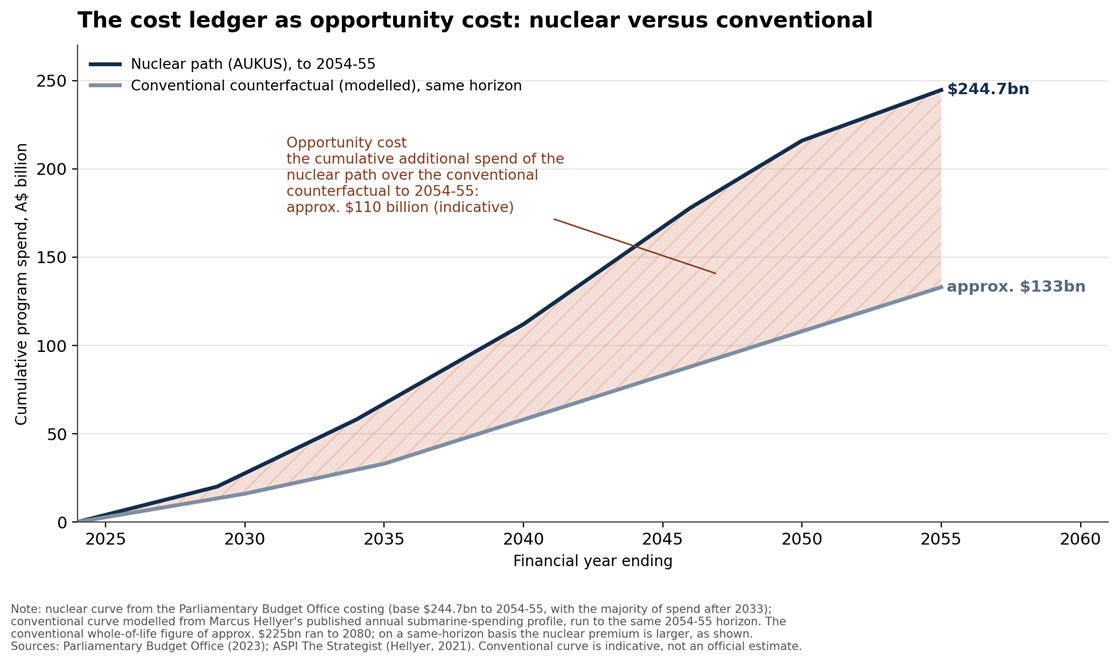
The cost ledger as opportunity cost: nuclear versus conventional. The cost ledger as cumulative spend. The nuclear curve is the Parliamentary Budget Office base costing to 2054-55; the conventional curve is modelled from published annual submarine-spending figures run to the same horizon. The shaded wedge between them is the opportunity cost: the additional money the nuclear path consumes over the conventional counterfactual, roughly $110 billion across the period. The conventional curve is indicative, not an official estimate.
Parsed honestly, then, the ledger reads: $244.7 billion base for eight nuclear boats to 2054-55, against roughly $225 billion, whole-of-life, for twelve conventional boats to 2080. The nuclear premium is real, but it is denominated in tens of billions across three decades, not the hundreds of billions the public debate implies. The $368 billion figure misleads most when it is set against the dead estimates of $36 billion or $50 billion, which described a different program, in a different denomination of dollars, at an earlier stage of candour. Per hull, the difference is stark: roughly $19 billion whole-of-life for each Attack class boat against roughly $31 billion base for each nuclear one. Per unit of strategic effect, it inverts: an SSN’s time on station north of the equator, which is where the deterrent effect lives, is a multiple of a conventional boat’s, because the SSN spends days in transit where the conventional boat spends weeks, and once there it stays until the food runs out. Costed per day of presence in the waters that matter, the nuclear boat is plausibly the cheaper submarine.
Hellyer’s analysis, written before AUKUS was announced, made the deeper point: between Collins sustainment, upgrades, workforce and the Attack class ramp-up, Australia was already spending $2.2 billion a year on its submarine capability and heading towards $5 billion a year under the conventional program. There was never a cheap option. The choice was always between an expensive conventional capability and a more expensive nuclear one, and the increment buys the geometry.
The opportunity cost, and what it could otherwise buy
There is, though, a more honest way to size the premium than the whole-of-life subtraction, and it is the one drawn in the chart above. Compared over the same window, to 2054-55, the nuclear path consumes something like $110 billion more than the conventional counterfactual would have. That figure is larger than the roughly $20 billion the headline whole-of-life numbers imply, because the conventional sustainment tail ran on to 2080: stop both clocks at the same year and the same horizon premium is bigger and the comparison fairer. Call the opportunity cost, then, on the order of $100 billion across three decades. The question a serious critic should press, and the official case rarely answers, is what else that money could buy, and whether the alternative would do the same work.
The sums involved buy a great deal of something. Australia’s entire purchase of more than two hundred Tomahawk cruise missiles cost about $1.3 billion; the Ghost Shark program of record for a fleet of large autonomous undersea vehicles is about $1.7 billion. Against those unit costs, $100 billion is, in crude arithmetic, thousands of long-range missiles, or many times over a national fleet of uncrewed underwater vehicles, or five or six more conventional submarines at the per hull figure derived above, or some combination of integrated air and missile defence, additional surface combatants, seabed warfare and long-range strike. On a pure spreadsheet of platforms and magazines, the conventional path plus a missile and drone buy looks like more capability for the money.
The test is whether any of it delivers the same strategic and operational effect, and here the answer is no, with one caveat worth taking seriously. Missiles are potent, but they punish rather than persist; a magazine is finite, it must be carried by a platform that can survive to launch, and it depends on a targeting chain that an adversary will work to break. Mass strike complements the submarine, it does not reproduce it; indeed the SSN is itself among the most survivable missile magazines available. Uncrewed underwater vehicles are the most interesting alternative and the most genuinely substitutable over time, cheap enough to be attritable and to be bought in numbers, but today they lack the range, endurance, payload and autonomy to hold the far north persistently against a capable navy. They extend the reach of the crewed submarine; they do not yet replace it. More conventional boats buy hulls but not the effect, because they inherit the very geometry problem the nuclear boat was chosen to solve: short dwell, vulnerable transit, an inability to reach and hold the waters where the deterrent effect actually lives. None of the alternatives delivers a survivable, sovereign, persistent and unlocatable instrument of sea denial operating far from home without permission. That specific effect, the one the hegemony and autonomy arguments above both rest on, is what the premium buys, and it is not on any cheaper shelf.
The caveat is the one that should keep planners honest. That judgement is true today. If attritable autonomy matures faster than the submarines arrive, and the trajectory of the Ghost Shark generation is not trivial, the opportunity-cost calculus shifts, and some of the effect now reserved to the SSN becomes available at a fraction of the cost. That is not an argument against the boats. It is an argument for buying the uncrewed layer in parallel rather than instead, which the 3 per cent envelope can now afford, and for keeping the hedge discussed earlier genuinely open.
Then why not simply buy eight Virginias?
There is one more alternative that deserves a straight answer, the more so because I have previously put it on the table myself: if the operational need is eight survivable SSNs, why not buy eight Virginias off the United States production line and skip the cost and risk of building our own? The arithmetic is seductive. At the US program of record price of roughly USD4.5 billion a hull, eight Virginias is on the order of USD36 billion, perhaps $55 to 70 billion once Australianised, against a base program of $244.7 billion. On a sticker comparison of hull for hull, the ‘build it here’ path looks like an extravagance and a heavy sovereignty premium. The trouble is that the comparison is false at both ends. It fails first on supply: there are not eight Virginias to buy. The American line is turning out 1.1 boats a year against a Navy requirement of 2.33, the sale of even three rests on a presidential certification that the transfer ‘will not degrade’ US undersea capability, and a request for eight more is not a procurement option, it is a fantasy the US production base cannot honour this side of the 2040s.
It fails second on what the sticker leaves out. The $244.7 billion is a whole-of-life figure carrying thirty years of sustainment, the infrastructure at Stirling and Osborne, the regulator, the workforce and the industrial base; eight imported hulls would still need most of that same enterprise to operate and maintain them in Australian waters, so the saving is a fraction of the headline gap. And it also fails on the very ground the autonomy argument stands on. A fleet of foreign-built boats with no domestic design authority, no sovereign sustainment and no build line is a capability Australia hosts rather than owns, perpetually dependent on American yards for deep maintenance and on Washington for spares, weapons and reactor support, and unable to refresh the design across a fifty year life. SSN-AUKUS costs more precisely because it buys the things the cheap option cannot: a sovereign capability Australia can sustain, evolve and command on its own account. Finally, a direct purchase obviates the strategic ‘pact’ that lies at the heart of AUKUS, discussed above. The eight Virginia shortcut is the right question to ask and asking it clarifies why the longer road was chosen. It is cheaper only if you do not count what it leaves out, and it’s unavailable in any case.
The workforce mountain
Money is the wrong place to look for the binding constraint. People are the binding constraint, and here the comparison with the conventional counterfactual is sobering.
The Attack class program was expected to generate an annual average of around 2,800 jobs, with at least 60 per cent of the contract value committed to Australian industry. The nuclear program’s demand is of a different order: around 20,000 direct jobs over the next thirty years across industry, the ADF and the public service, including up to 4,000 workers building the Osborne construction yard and a further 4,000 to 5,500 building the submarines at peak, with around 3,000 direct jobs in Western Australia supporting SRF-West and sustainment as up to $8 billion is invested at HMAS Stirling. Against the conventional baseline, peak direct industrial demand roughly triples.
The uniformed picture is steeper still. The Navy’s trained submarine workforce stood at 881 in early 2021, the product of years of deliberate effort, and sits around 900 today. A Collins boat sails with a crew of around 55; a Virginia sails with 132. Crewing three Virginias while continuing to crew six Collins through their life extension, and then crewing SSN-AUKUS, requires the submarine workforce to grow to around 3,000. That is a tripling of a workforce that took two decades to grow to its current strength, in a labour market where every other national megaproject is bidding for the same engineers and technicians.
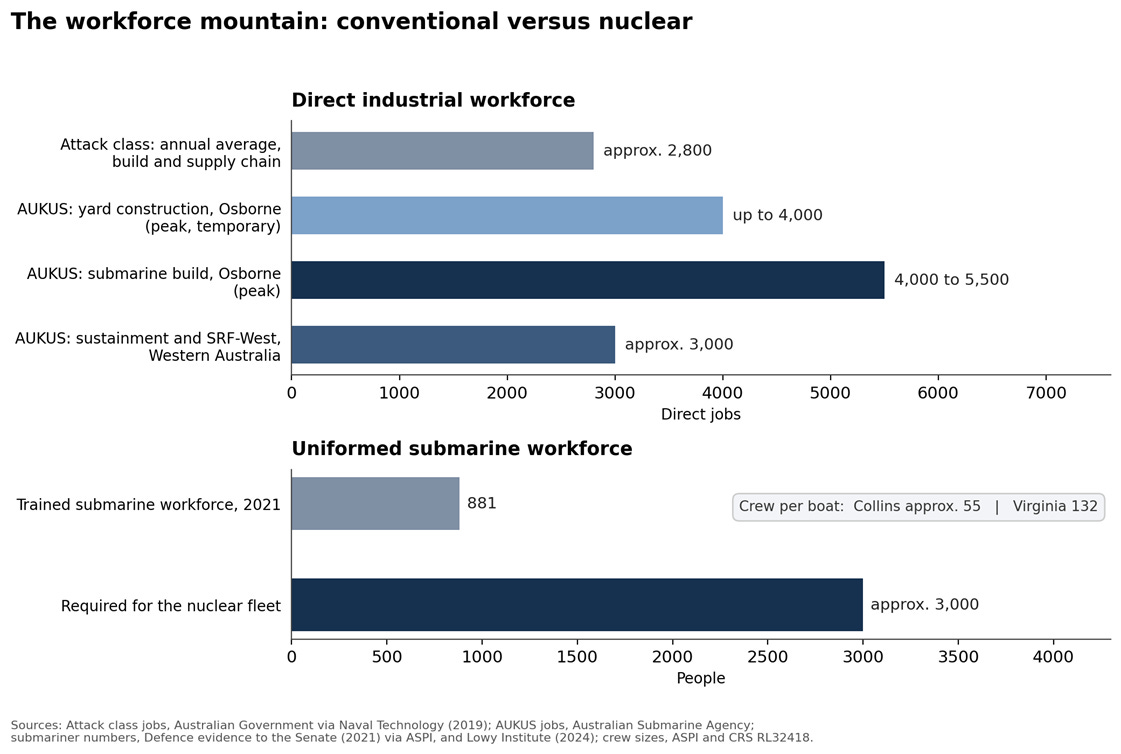
The workforce mountain: conventional versus nuclear. The workforce mountain. Attack class jobs are the program’s expected annual average; AUKUS figures are Australian Submarine Agency peak estimates, with yard construction temporary; uniformed figures from Defence evidence to the Senate and the Lowy Institute.
Which skills carry across, and which do not? The reassuring half of the answer: most of the trades and disciplines that build and sustain a conventional submarine build and sustain a nuclear one. Welding, pipefitting, electrical trades, combat systems integration, sonar, signature management, weapons handling, logistics, project and supply chain management: three decades of building and sustaining the Collins at Osborne and Henderson created the ecosystem AUKUS now leverages, and that ecosystem is the reason Australia is a credible candidate for this program at all. The demanding half: everything nuclear is new. Reactor operation and nuclear engineering, radiological protection and health physics, nuclear grade quality assurance and the welding standards that go with it, and above all the safety case culture, the institutional habit of proving safety before acting, that distinguishes nuclear enterprises from every other industrial undertaking. None of this existed in Australia at scale, and the regulatory layer is being built alongside it: the Australian Naval Nuclear Power Safety Act 2024 established a dedicated regulator for the program’s designated zones at Stirling and Osborne.
The pipeline this decade looks like this: over 120 RAN officers and sailors in US nuclear training pipelines, including Nuclear Power School; ASC workers embedded at Pearl Harbor Naval Shipyard and 200 new apprentice, trainee and graduate places at ASC; and a $480 million Skills and Training Academy at Osborne operating from 2028 to retrain welders, electricians and engineers in nuclear specific competencies. SRF-West, from 2027, is the classroom that matters most: Australian crews and maintainers working on live nuclear submarines at home, a decade before the first Australian flagged boat arrives.
The next decade is where the mountain steepens. The 2030s demand everything simultaneously: sustaining the Collins through its life of type extension, operating and sustaining three Virginias, standing up the Osborne build, and growing the SSN-AUKUS design and construction workforce, with the same finite pool of people stretched across all four. The official strategy assumes recruitment and retention rates that Defence has historically struggled to achieve. The money can be appropriated on a single budget night. A nuclear qualified welder takes years to certify; a submarine commanding officer takes fifteen years to grow; a safety culture takes a generation. That, not the $368 billion, is the number to watch.
Pillar 2: the near term strategic dividend
The public debate about AUKUS is dominated by the submarine program: the timelines, the costs, the industrial base concerns. This is understandable but distorting. Pillar 2, the advanced capabilities stream, is arguably more immediately significant to Australia’s defence posture than Pillar 1, and it is delivering capability today.
The eight working group domains established under Pillar 2 (undersea capabilities, quantum technologies, artificial intelligence and autonomy, advanced cyber, hypersonic and counter-hypersonic capabilities, electronic warfare, innovation, and information sharing) represent the most ambitious trilateral advanced capability program in the history of the alliance. The Congressional Research Service has noted that ‘in contrast to Pillar 1 activities, which may take decades to deliver results, some analysts and policymakers expect AUKUS Pillar 2 to produce more immediate capability improvements’. BAE Systems’ analysis is blunter: Pillar 2 offers a contribution to the partnership’s objectives ‘certainly sooner than the delivery of a long-term, capital-intensive programme such as engineering nuclear-powered submarines’.
The AUKUS Undersea Robotics Autonomous Systems project is developing autonomous underwater vehicles as a force multiplier for maritime forces, with the inaugural Pillar 2 Signature Project, developing advanced payloads for uncrewed undersea vehicles with delivery from 2027, announced at the May 2026 Defence Ministers meeting. These systems will be capable of protecting critical seabed infrastructure, deploying surveillance and strike payloads, mine countermeasures, anti-submarine warfare and contested littoral manoeuvre. They are tools ready for combat, not concept demonstrators.
The AUKUS Quantum Arrangement accelerates quantum technologies for positioning, navigation and timing, maintaining GPS independent navigation in contested electromagnetic environments, with trilateral quantum positioning, navigation and timing work accelerating. In a conflict where GPS satellites are degraded or denied, this capability becomes operationally decisive. The Resilient and Autonomous Artificial Intelligence Technologies programme delivers AI algorithms for force protection, precision targeting and intelligence, surveillance and reconnaissance, with all three nations sharing AI models and conducting live retraining trials, including a 2023 trilateral trial in which AI enabled swarms detected and tracked military targets in real time.
Perhaps the most structurally significant Pillar 2 development is the reform of export controls. The Defence Trade Controls Amendment Act 2024, combined with the AUKUS export control exemption under the FY2024 NDAA, certified by the State Department on 15 August 2024, means that most defence items can now transfer between the three countries without further authorisation. The ITAR logjam, a genuine impediment to Pillar 2 implementation, has been substantially addressed. For Australian defence industry, this represents access to the deepest technology commons in history.
What the parliaments found
Australia’s parliament has scrutinised AUKUS through the Joint Standing Committee on Treaties, which has conducted three successive inquiries: into the Exchange of Naval Nuclear Propulsion Information Agreement in 2021-22, the AUKUS Naval Nuclear Propulsion Cooperation Agreement in 2024-25, and the Geelong Treaty in 2025. These are legally required treaty scrutiny processes. They are not a substitute for what Australia has conspicuously failed to conduct: a dedicated parliamentary inquiry into the strategic rationale, implementation risks, cost estimates and opportunity costs of the largest single defence commitment in the nation’s history.
Former Environment Minister Peter Garrett put the incongruity with precision at the launch of the AUKUS Public Inquiry in June 2026: parliamentary inquiries are a cornerstone of Australian democracy, with some 88 underway on everything from the tyre industry to the NDIS, ‘yet for AUKUS, we are not having one’. The inquiry, a civil society process with Garrett as lead commissioner and former Chief of the Defence Force Admiral Chris Barrie among the commissioners, reflects a demand the Australia Institute and a roll call of defence figures have pressed since 2023. Barrie’s concern is worth taking seriously: ‘My fear as a former chief of the defence force is that the kinds of expenditures and the kinds of workforce… might drain other parts of our defence force and leave us vulnerable in ways that we would not appreciate.’ The Greens’ motion to cancel AUKUS after the 2024 US election was defeated in the Senate 12 votes to 26; bipartisan support held. But the democratic deficit is real, and a full parliamentary inquiry, far from threatening AUKUS, would strengthen its legitimacy.
No parliament has scrutinised AUKUS more intensively than the US Congress, and the scrutiny has been productive. The House Armed Services Committee hearing of October 2023 on the submarine industrial base was the most substantive public examination of Pillar 1 feasibility. Rear Admiral Jonathan Rucker told the committee plainly that the construction rate ‘has resulted in the annual production rate of 1.2 to 1.3 Virginia-class per year, compared to our goal of two per year’. The Congressional Budget Office confirmed in April 2026 testimony that the production rate for the preceding two years was only 1.1 boats per year. The Navy’s own arithmetic puts the rate required to execute its procurement, replace AUKUS sales and reduce the accumulated backlog at 2.33. Senators Reed and Inhofe warned President Biden in December 2022 that AUKUS risked becoming ‘a zero-sum game for scarce, highly advanced U.S. SSNs’. In July 2023, Senators Wicker and Collins led more than twenty colleagues in demanding a multi-year plan to lift Virginia class production to a minimum of 2.5 per year. Nonetheless, the FY2024 NDAA passed the House by 310 votes, an emphatic bipartisan majority, authorising the transfers and accepting Australia’s $3 billion contribution to the US submarine industrial base.
The UK’s House of Commons Defence Committee report of April 2026, after a year long inquiry that visited UK, US and Australian sites, was the most comprehensive parliamentary examination produced by any of the three partners; its title alone was an instruction to government: do more, and do it faster. Chair Tan Dhesi MP was direct: ‘Any undertaking of this scale requires committed, consistent political will and leadership. Unfortunately, we found that the UK’s political leadership on AUKUS has dwindled.’ The Committee found specific failings at Barrow-in-Furness, in UK submarine availability and in Pillar 2 delivery pace. The Lords International Agreements Committee noted that the Article 14 arrangement with the IAEA remained to be concluded. UK Defence Readiness Minister Luke Pollard’s response acknowledged that ‘the necessity of ensuring AUKUS delivers is even more critical than when the original initiative was introduced years ago’. That is parliamentary scrutiny doing its job.
The sceptics deserve answers
The accommodation thesis
There are a number of AUKUS sceptics with formidable arguments that deserve engagement on their merits. Most cases rests on five propositions: US primacy is unrestorable; AUKUS locks Australia into war alongside the United States if conflict with China erupts over Taiwan; the submarines won’t arrive in time to shape the strategic environment; conventional submarines may be more cost effective; and the US production rate makes the whole programme implausible in any case.
Some of these observations contain real analytical substance. The industrial base concern is legitimate and addressed below. The timing challenge is genuine. But the overarching thesis, that Australia should accommodate China’s rise rather than contribute to deterring it, is not a strategic alternative. It is a counsel of despair dressed as realism.
Writing in The Conversation in June 2025, Hugh White, for example, argued: ‘The suggestion that the AUKUS program poses an effective deterrent to China’s strategic ambitions in the decades ahead looks absurd against the reality that it will deliver no substantial new capability until the 2050s.’ This is a strawman. AUKUS will deliver strategic effects today through SRF-West; it should deliver Virginia class submarines in the early 2030s; SSN-AUKUS should start arriving in the early 2040s. The mid-2050s date refers to the completion of the full eight boat fleet, not the arrival of strategic effect.
More fundamentally, the accommodation thesis has no answer to the question: accommodation on what terms? A China centred regional order in which Australia has traded its alliance relationship and independent capability for a degree of tolerance from Beijing is not a stable equilibrium. It is a vulnerability. The goal of AUKUS supporters is not US dominance. It is, as Gosling argued at the launch of his Lowy paper, ‘a sustainable balance in the Indo-Pacific in which no one country in our region is militarily dominant’. White is right that a US-China war over Taiwan would be catastrophic. That is precisely the argument for deterrence, which by definition aims to make war less likely by making it more costly. The historical record of appeasement is not ambiguous on this point.
The nonproliferation critique
James Acton’s 2021 Carnegie analysis was the earliest and most rigorous statement of the nonproliferation concern: ‘The nonproliferation implications of the AUKUS submarine deal are both negative and serious… I am concerned that this removal [of nuclear material from IAEA safeguards] will set a damaging precedent.’ The Arms Control Association’s Dalton and Levite added that the current arrangements ‘do not meet the high nonproliferation bar that the parties have set for themselves’, partly because they rely on ‘inherently reversible, unilateral or trilateral policy choices’.
The factual response has three parts. First, the sealed power unit design makes diversion operationally impossible without completely disassembling the submarine’s reactor compartment, a months long industrial operation impossible to conceal. Second, the agreement legally prohibits Australia from enriching uranium or reprocessing fuel, eliminating the fuel cycle pathway to weapons. Third, the Article 14 arrangement being negotiated with the IAEA, publicly confirmed by the Director General as actively progressing, will establish verification measures tailored to this unique situation. The Geneva Centre for Security Policy’s November 2024 analysis argues persuasively that AUKUS adheres to the established rules of the safeguards system rather than exploiting a loophole, and has the potential to ‘establish new norms in international nuclear governance’. That potential is real, but only if the Article 14 negotiations conclude with genuinely robust verification.
China’s use of nonproliferation arguments at the IAEA, lobbying the Board to obstruct AUKUS implementation and demanding the Secretariat refuse to engage with the three countries, is worth noting in this context. A government genuinely indifferent to AUKUS’s strategic implications would not invest such diplomatic capital in opposing it.
The industrial base problem: the real constraint
The most serious practical challenge to Pillar 1 is not strategic or diplomatic. It is industrial. The US submarine industrial base is producing Virginia class boats at 1.1 per year against a stated requirement of 2.0, with the 2.33 rate required to meet both US Navy needs and AUKUS commitments likely unavailable until well into the 2030s at the earliest. The Government Accountability Office found in March 2025 that ‘marginal changes within the existing acquisition structures are unlikely to provide the foundational shift needed to break the pervasive cycle of delivery delays and cost overruns’. This is a genuine problem, not a partisan talking point.
But three mitigants matter. First, the three governments have collectively invested approximately USD10 billion in the submarine industrial base since 2018, and HII, Newport News Shipbuilding’s parent, reported a 14 per cent year over year throughput increase across its yards in 2025, targeting a further 15 per cent in 2026. The investment is producing results, even if slowly. Second, SRF-West, which begins in 2027 and delivers immediate strategic effect, does not depend on production rate achievements. Third, the May 2026 decision to streamline the Virginia class purchase to in-service boats rather than a mixture of new construction and in-service variants reduces the production burden and simplifies operational integration. The production constraint is the hardest factual challenge AUKUS faces. It is not a reason to abandon AUKUS. It is a reason to invest more in fixing the US submarine industrial base, which AUKUS itself is providing the political mandate to do.
The cost sceptics
Former Prime Minister Malcolm Turnbull told Chatham House in May 2026 that AUKUS is ‘a huge wealth transfer from the Australian government to the US and the UK’. The Australia Institute’s Allan Behm has called it ‘unachievable’. The ledger set out earlier in this post is the first answer: the conventional path Australia was already on carried a whole-of-life cost around $225 billion and rising, for a fleet with a fraction of the presence where presence matters. The genuinely additional cost of the nuclear path is a fraction of the headline number that anchors the public debate. The second answer is the counterfactual the cost sceptics never price: what is the cost of strategic failure? Of an Indo-Pacific in which China has established sea control in Australia’s maritime approaches, in which the US alliance has been hollowed by Australia’s failure to invest in alliance value, and in which Australia’s access to North Asian markets, approximately 75 per cent of its exports, is subject to political conditionality? The ‘wealth transfer’ framing misses both ledgers: the wealth Australia is committing buys sovereign capability, industrial knowledge, alliance depth and deterrence effect that cannot be acquired any other way, and the alternative submarine program was never cheap.
The regional critique
ASEAN’s initial concerns about AUKUS were real, and Indonesia in particular was vocal: its Foreign Ministry declared itself ‘deeply concerned over the continuing arms race and power projection in the region’. These concerns should not be dismissed. Australia has obligations to manage its regional relationships with care. But Indonesia’s position evolved. By 2023-24, Prabowo Subianto, then Defence Minister and now President, had moved to pragmatic acceptance. Vietnam and the Philippines viewed AUKUS as a welcome step toward strategic balance. Japan welcomed it and participates in Pillar 2 discussions. New Zealand’s nuclear free policy prevents it from hosting SSNs in its internal waters, but Wellington has explicitly expressed interest in non-nuclear Pillar 2 cooperation. China’s objections are the loudest but should be weighed against their source. Beijing’s interests are best served by an Australia undefended, an alliance structure weakened, and a regional order shaped by Chinese preference. Its objections to AUKUS are geopolitical rather than principled.
The Trump administration review
When the Pentagon initiated a thirty day AUKUS review in June 2025, led by Under Secretary of Defense Elbridge Colby, the response in Canberra and London was anxious. Colby had expressed concern that selling submarines to Australia ‘could put the US Navy in a weaker position since they weren’t going to American submarine development’. The review concluded in December 2025 with a ‘full steam ahead’ directive from President Trump. Then UK Defence Secretary John Healey was direct: ‘The reviews are done. It’s time to deliver.’ AUKUS has now survived changes of government in all three capitals, for the reason set out at the start of this post: each capital is solving its own problem with the same program, and Washington’s gains, forward access to Stirling, reduced transit and maintenance costs, non-refundable industrial base investment, and a capable allied navy in the critical sea lanes, are concrete.
What AUKUS buys
By committing to host US and UK nuclear-powered submarines, to train alongside their submarine forces, to purchase Virginia class boats and to jointly build SSN-AUKUS, Australia has embedded itself in the US strategic calculus at a depth that changes the calculations of any adversary considering action against Australian interests. An adversary planning to coerce Australia must now factor in that Australian and US submarine forces are operationally integrated, that Australian naval infrastructure is US force posture infrastructure, and that Australian strategic decisions engage US strategic equities in ways no treaty text alone could establish. This is extended deterrence operationalised through shared industrial, operational and human capital.
The 2026 NDS represents a qualitative step beyond its 2024 predecessor. It elevates self-reliance as a formal strategic objective for the first time. It commits to defence spending of 3 per cent of GDP by 2033, a NATO comparable benchmark. It acknowledges the force projection risks ‘not seen since WWII’ and backs the framing with $14 billion additional over four years and $53 billion over the decade. INDOPACOM Commander Admiral Paparo told the Senate Armed Services Committee in April 2026 that AUKUS progress at Stirling was real and substantive: ‘It’s now as much up to industry as anyone else to deliver.’ The operational infrastructure is in place. The political commitment across all three capitals is intact. The gap is industrial, and it is being addressed.
Beyond the submarines, AUKUS is delivering a defence industrial transformation that would not otherwise be possible: approximately twenty thousand direct jobs over thirty years in design, construction, maintenance and the supply chain, carrying skills in nuclear engineering, advanced manufacturing and systems integration that Australia has never previously developed at scale. A trilateral SSN-AUKUS production line shared between Barrow-in-Furness and Osborne represents, when completed, an allied undersea capability that changes the military balance of the Indo-Pacific, and of the North Atlantic.
The opportunity cost question is honest and important: what capabilities are foregone by committing to AUKUS? The answer includes some near term conventional investment, some surface fleet modernisation priority, and some fiscal bandwidth that might have gone to air, cyber or land capabilities. ASPI analysts warned well before the 2026 strategy that going full steam ahead on nuclear submarines risked pushing the Collins class to the brink, and that the funding envelope of the early 2020s could not carry the transition and the rest of the force at once. The 3 per cent commitment directly addresses that concern. At that funding level, Australia can sustain the Collins through the transition, maintain the ADF’s current capability development trajectory and invest in AUKUS. At the old envelope of just over 2 per cent of GDP, it could not. The strategic case for higher defence spending is itself partly AUKUS’s contribution to the political economy of Australian defence.
A generational wager
AUKUS is imperfect. The timelines are ambitious, the industrial base constraints are real, the nonproliferation questions have not been entirely resolved, and the cost is genuinely large even when measured honestly against the program it replaced. The UK’s parliamentary committee is right that political will must come from the top and be sustained across electoral cycles. The certification clause is a trapdoor that deserves a stated hedge rather than official optimism. The workforce mountain, not the money, is the binding constraint on delivery. And Australia’s own absence of a comprehensive parliamentary inquiry into its largest ever defence commitment is a democratic accountability gap that should be closed, not least because an inquiry is the mechanism most likely to force the hedging questions posed in this post onto the public record.
But the strategic alternatives are worse. A conventional only submarine force cannot provide the operational geometry that Australia’s reversed tyranny of distance requires. Accommodation of an increasingly assertive revisionist power has no precedent of success where the power in question holds expansive territorial claims and uses economic coercion as an instrument of policy. Disengagement from the US alliance would leave Australia with neither the capability nor the deterrence protection to navigate the polycrisis environment the 2026 NDS so clearly describes.
The original joint leaders statement committed three nations to ‘a shared ambition to support Australia in acquiring nuclear-powered submarines for the Royal Australian Navy’ in order to ‘sustain peace and stability in the Indo-Pacific region’. Nearly five years on, that commitment has survived three changes of government in Australia and the UK, a presidential transition in the United States that began with scepticism and concluded with endorsement, parliamentary scrutiny in all three capitals, and a sustained campaign of opposition from China, the nonproliferation community and domestic critics ranging from the considered realism of Hugh White to those who would simply cancel the programme.
Australia’s future security will be shaped by decisions made in the next decade. AUKUS is the centrepiece of those decisions, not because it is risk free, but because deterrence requires capability, and capability requires commitment well before the crisis arrives. The warning time that disappeared was the period in which comfortable assumptions held. The period ahead requires what the motto of my Substack promises: if you want peace, prepare for war.
That is a wager worth making, with eyes open.